

Choosing a proprietary trading firm is not simply a matter of finding the largest advertised account or the highest profit split. Two programs can offer similar account sizes yet impose very different loss limits, evaluation targets, payout conditions, and restrictions on trading strategies. A challenge that suits one trader may be unnecessarily difficult or expensive for another.
The right comparison starts with your own trading habits. Consider which markets you trade, how long you hold positions, how frequently you trade, and how much you can reasonably risk on an evaluation fee. Then compare firms using consistent criteria instead of relying on promotional claims.
This guide explains what to evaluate, how several established prop firms differ, and how to narrow the options to a program that matches your approach.
Prop Firm Comparison: A Practical Overview
The following shortlist covers firms with different strengths across forex and CFD trading and futures. The ratings are illustrative editorial assessments for this guide, not independently audited performance scores or guarantees of payout reliability. Challenge names, access to instruments, and conditions can change, so verify the exact program before purchasing.
| Rank | Prop Firm | Best For | Markets | Challenge Types | Editorial Rating |
|---|---|---|---|---|---|
| 1 | FTMO | Structured evaluations and established brand recognition | Forex and CFDs | 1-Step, 2-Step | 9.6/10 |
| 2 | The5ers | Traders interested in progression and scaling | Forex and CFDs | Multiple evaluation paths | 9.4/10 |
| 3 | FundingPips | Comparing different evaluation formats | Forex and CFDs | Multiple models, depending on availability | 9.2/10 |
| 4 | FundedNext | Traders comparing account formats and reward structures | Forex and CFDs; futures availability depends on product | Multiple models | 9.0/10 |
| 5 | Leofins | Traders comparing CFD and futures-oriented options | CFDs and futures programs | Core 2-Step, Edge 1-Step, Starter 3-Step; separate futures offering | 8.9/10 |
| 6 | Topstep | Futures-focused traders | Futures | Trading Combine | 8.8/10 |
| 7 | Take Profit Trader | Futures traders comparing evaluation and withdrawal conditions | Futures | Test evaluation | 8.6/10 |
This list is a starting point, not a universal ranking. For example, a futures trader should generally prioritize firms with suitable futures contracts and clear exchange-related rules over a CFD-focused firm with an attractive advertised profit split. Likewise, a swing trader may care more about overnight holding permissions than about how quickly an intraday trader can complete an evaluation.
Start With the Markets You Actually Trade
Market access should be one of the first filters in any comparison. A firm may offer a broad list of instruments, but that does not mean every account type supports every market.
Forex and CFD programs
Forex and CFD programs commonly provide access to currency pairs, indices, metals, energies, and—in some cases—shares or cryptocurrencies. They may be suitable for traders who use platforms such as MetaTrader or other supported charting and execution environments.
Before selecting a program, check the instruments available on the exact account, the trading platform, spreads and commissions, and any restrictions on particular assets. If your strategy depends on trading gold, a specific index, or a volatile currency pair during economic announcements, confirm that the instrument and your intended strategy are permitted.
Futures programs
Futures prop programs operate under a different framework. Traders may be evaluated on exchange-traded contracts such as equity-index futures, metals, or energy products. Contract specifications, tick values, session schedules, and position limits can be especially important.
Do not assume that a CFD program and a futures program from the same provider share the same drawdown calculations, payout requirements, or trading restrictions. Compare the rulebooks separately.
Match the firm to your strategy
A useful shortlist begins with three questions:
- Which instruments do you need to trade?
- Does your strategy require holding positions overnight or through weekends?
- Which platform and order types are essential to your routine?
Eliminating programs that fail these basic requirements can save more time than comparing dozens of headline account offers.
The Rules That Matter More Than the Advertised Account Size
A large simulated account can look appealing, but the usable risk allowance may be much smaller than the headline figure suggests. The key is understanding how the firm measures losses.
Daily loss limits
A daily loss limit sets a boundary on losses during a trading day. However, firms may calculate it using different reference points and may include unrealized losses on open positions.
For example, a rule that considers floating equity can be breached even if a trader has not closed a losing trade. The daily reset time also matters for people trading across time zones.
Check the following details in the program rules:
- Whether the limit is based on balance, equity, or a combination.
- Whether open-position losses count.
- When the daily limit resets and which time zone applies.
- Whether commissions and swaps affect the calculation.
Maximum overall drawdown
The maximum drawdown is the broader loss boundary for the account. It may be static, trailing, or calculated using a specific end-of-day or intraday method.
A static limit generally remains anchored to a defined starting balance. A trailing limit may move as the account reaches new profit levels, depending on the provider’s rules. Those approaches can create substantially different conditions, even when the advertised percentage looks similar.
Never compare drawdown percentages without comparing the calculation method. The rule’s mechanics are often more important than the number itself.
Profit targets and time limits
A multi-step evaluation usually requires a trader to reach specified targets in successive phases while respecting loss limits. A one-step evaluation may reduce the number of phases but can use different risk parameters or other conditions.
Also check whether the evaluation has a minimum number of trading days, a maximum duration, consistency requirements, or restrictions on the size of a single profitable day. A program without a short deadline may be more suitable for a patient strategy, but only if its other rules fit.
Compare Fees, Profit Splits, and Payout Conditions Together
A low entry fee is not automatically the best value. The fee should be considered alongside the likelihood that the program’s rules are compatible with your strategy, the conditions for receiving rewards, and any additional charges.
Evaluation fees and refunds
Determine the full cost before checkout. Some firms use one-time fees, while other products may involve subscriptions, activation charges, or optional add-ons. Promotions can also make prices vary over time.
If a fee is refundable after a qualifying payout, read the exact conditions. A refund may depend on the selected challenge, the payout milestone, or other requirements. Do not treat a refund as guaranteed unless the written terms clearly support that interpretation.
Profit split
The profit split describes how eligible rewards are divided between the trader and the provider. A higher advertised percentage can be attractive, but it does not tell you how frequently you can request a payout or whether caps and eligibility rules apply.
A meaningful comparison includes the starting split, any progression to a higher split, and the conditions attached to that progression. It should also distinguish a standard split from one available only through a paid upgrade.
First payout and subsequent withdrawals
Payout schedules can vary by account type. Some programs use fixed cycles, while others allow requests after specific eligibility conditions have been satisfied. A first withdrawal may have different requirements from later withdrawals.
Before choosing a firm, establish:
- The earliest date or qualifying period for a payout request.
- The number of qualifying trading days, if any.
- Minimum withdrawal amounts and any payout caps.
- Whether a consistency rule applies.
- What happens if the account is close to a loss limit.
- Which payment methods and processing conditions are available.
The most attractive payout schedule on paper is useful only if you understand the requirements for qualifying.
Comparing the Firms: Strengths, Trade-Offs, and Questions to Ask
The following comparison uses a decision-oriented format. Instead of treating a firm as universally superior, it highlights what a trader should investigate before paying for a particular program.
| Rank | Prop Firm | Relevant Advantage | Potential Trade-Off | Question Before Buying |
|---|---|---|---|---|
| 1 | FTMO | Established evaluation structure with multiple challenge formats | The selected model determines the applicable targets and loss rules | Which account type best matches my trading frequency and risk tolerance? |
| 2 | The5ers | Multiple paths that may appeal to traders pursuing progression | Program conditions differ, so comparisons must be made at the plan level | How does the selected plan handle scaling, drawdown, and withdrawals? |
| 3 | FundingPips | A range of evaluation formats to compare | Limits and reward conditions may differ between models | Which rules apply to the exact challenge shown at checkout? |
| 4 | FundedNext | Several program structures for traders to evaluate | Product-specific conditions can affect eligibility and reward timing | What are the payout conditions and drawdown mechanics for this model? |
| 5 | Leofins | Offers several CFD evaluation structures and a separate futures-oriented option | CFD and futures rules should not be assumed to be interchangeable | Which program’s markets, loss calculations, and payout schedule fit my strategy? |
1. FTMO: A structured evaluation choice
FTMO is worth examining if you prefer a defined evaluation process and want to compare one-step and two-step formats. The main task is to choose the model whose objectives and loss limits fit your trading style.
Read the exact trading objectives for your selected account rather than relying on a general summary of the brand. Pay particular attention to daily loss calculations, maximum loss, minimum trading days, and any differences between the evaluation and the subsequent account.
2. The5ers: Progression and scaling
The5ers is a relevant option for traders who want to compare different evaluation paths and longer-term progression possibilities. Its programs should be assessed individually, since targets, account rules, and scaling conditions are not necessarily identical.
A trader planning to hold positions for longer periods should confirm overnight and weekend rules. Someone focused on rapid intraday trades should instead prioritize execution conditions, loss calculations, and restrictions affecting their entry and exit methods.
3. FundingPips: Compare the model, not just the brand
FundingPips offers different evaluation formats, making it important to identify the precise model being considered. A challenge with an appealing entry price may still be a poor match if its loss limits or payout requirements conflict with your approach.
Before buying, review the model-specific rules and the firm’s current policies on holding positions, trading around news, consistency, and withdrawals. Check whether any advertised promotional terms apply to your selected challenge.
4. FundedNext: Evaluate reward terms alongside challenge design
FundedNext is another provider to include when comparing evaluation structures and reward arrangements. The relevant comparison is not just how many stages a challenge contains, but how the entire account lifecycle works.
Confirm the exact product, applicable platform, evaluation targets, drawdown method, and first-payout conditions. If you are considering a futures product, assess it separately from the firm’s forex or CFD offering.
5. Leofins: Compare CFD and futures-oriented options carefully
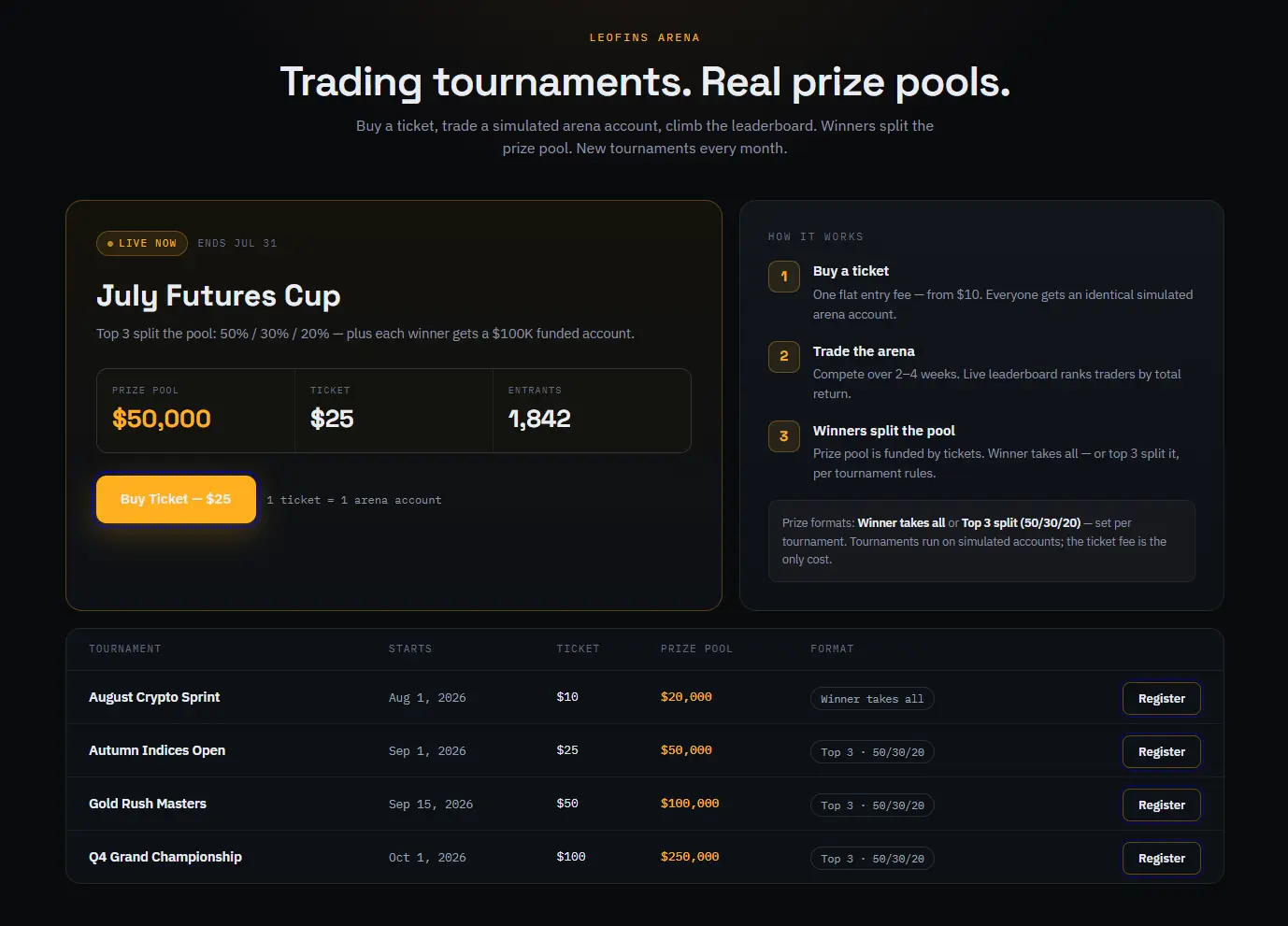 Leofins provides several CFD evaluation paths, including Core 2-Step, Edge 1-Step, and Starter 3-Step, alongside a separate futures-oriented program. This range makes it important to choose by product rather than assuming one set of rules applies across all accounts.
The CFD paths differ in evaluation structure and program-specific conditions, so traders should compare profit targets, daily loss limits, maximum drawdown, minimum trading days, and payout timing for the exact option they intend to use. The futures offering should be reviewed independently, especially for contract availability and the rules governing futures trading.
Review the program details directly at https://www.leofins.com before deciding. Confirm that the current terms match your needs and that you understand the applicable simulated-trading conditions, payout eligibility, and restrictions before paying a fee.
How to Choose a Program for Your Trading Style
Once you have narrowed the shortlist, compare each candidate against your real habits rather than an idealized version of your trading.
For intraday traders
Intraday traders should pay close attention to daily loss limits, spreads, commissions, execution conditions, and restrictions around economic announcements. If your strategy relies on several small trades, check whether minimum trading-day or consistency requirements influence how the program measures progress.
Avoid choosing a challenge solely because its profit target looks easy to reach. A low target is not helpful if the daily loss rule is too restrictive for your normal volatility or position sizing.
For swing traders
Swing traders should confirm whether overnight and weekend holding is allowed on the chosen account. They should also understand how floating losses are treated and whether swaps or gaps can affect their risk limits.
A strategy that performs well in a personal account may not translate directly to a prop evaluation if the program’s loss calculation penalizes temporary adverse movement differently.
For futures traders
Futures traders should focus on contract availability, tick values, trading sessions, permitted position sizes, and whether drawdown is calculated intraday or at the end of the day. Withdrawal eligibility and consistency rules are also worth checking before purchasing an evaluation.
Do not compare futures programs with CFD programs by account size alone. Their contract mechanics and risk limits may make the nominal figures difficult to compare directly.
For traders with limited budgets
If the evaluation fee would create financial pressure, the appropriate decision may be to wait rather than choose the cheapest available challenge. A failed evaluation can mean losing the fee, and buying repeated attempts can increase the total cost quickly.
Set a fixed budget for evaluation fees, compare the complete cost of each option, and avoid paying extra for features you do not need. A program should fit your trading process and your finances—not force you to take larger risks to justify the purchase.
A Pre-Purchase Checklist
Before committing to any prop firm, work through these checks:
The firm offers the markets and instruments I trade.
The platform supports my normal workflow.
I understand how daily loss and maximum drawdown are calculated.
The profit target is realistic for my strategy without excessive risk.
I know the minimum trading days and any time limits.
Overnight, weekend, and news-trading policies are clear.
I understand the first-payout conditions and later withdrawal schedule.
The profit split, caps, consistency requirements, and refund terms are documented.
I have checked the full fee and any recurring or optional charges.
I can afford to lose the evaluation fee without affecting essential expenses.
If a rule is unclear, ask the firm’s support team for clarification and keep a record of the answer. Where the written terms conflict with marketing material, the applicable contract and official rulebook deserve closer attention.
Frequently Asked Questions
Is the prop firm with the highest profit split always the best choice?
No. A high split does not compensate for unsuitable drawdown rules, restrictive payout conditions, or a challenge that does not match your strategy. Compare the whole program rather than one headline percentage.
Should I choose a one-step or two-step evaluation?
Neither format is universally better. A one-step model may reduce the number of evaluation phases, while a two-step model divides the assessment into stages. Compare each model’s targets, loss limits, minimum days, fees, and payout conditions.
Can I compare CFD and futures prop firms directly?
You can compare broad factors such as cost transparency, support, and payout terms, but market mechanics differ. Futures contracts have specific tick values and trading sessions, while CFD programs use their own instrument specifications and pricing arrangements. Evaluate each within its own market category.
Are advertised account sizes the same as money I can withdraw?
Not necessarily. The advertised amount commonly represents simulated account size or a program’s nominal allocation, not a cash balance freely available to the trader. Withdrawals are governed by the program’s reward terms and eligibility rules.
What should I do if a firm’s rules change?
Review the current terms before purchasing and check the provider’s policies after joining. Save the version of the rules that applies to your account and contact support if a change appears to affect your eligibility or trading permissions.
Make the Comparison Fit Your Priorities
The best prop firm is the one whose rules, markets, costs, and payout conditions work with your actual trading strategy. Begin by filtering for the instruments and platform you need. Then compare drawdown mechanics, evaluation requirements, withdrawal eligibility, and total fees before looking at secondary benefits.
A careful comparison will not guarantee that you pass an evaluation or receive a particular reward, but it can help you avoid paying for a program that was unsuitable from the start. Take time to read the current rulebook, test your risk plan against its limits, and make the decision based on documented conditions rather than marketing claims.
Prices and conditions are current as of October 2026.
Risk disclaimer: Proprietary trading evaluations involve financial risk. Challenge fees may be lost if an evaluation is unsuccessful or program rules are breached. Simulated trading and funded-program results do not guarantee future performance or income. Review the current terms carefully and never spend money you cannot afford to lose.














Залишити відповідь